Some materials are chosen for their looks. A few are chosen because almost no one else can work them. Nero Portoro is both: a black marble threaded with gold that has been coveted since antiquity, and one of the most difficult stones a workshop can take on. It is the material behind our flagship humidor, and it deserves a story of its own.
A single quarry on the Italian coast
Nero Portoro is quarried at a single, limited site near Portovenere, on the Ligurian coast of Italy. Its deep black background, crossed by veins of gold and white, made it one of the most prized stones of the Roman world, later reserved for the grandest architecture and the finest decorative work. Because the source is so small, the supply is genuinely limited: this is not a marble you can order by the pallet.
Black and gold, and never the same twice
What sets Nero Portoro apart is the contrast. The black is unusually deep, and the gold veining runs across it like brushstrokes, warm against the dark. No two blocks are alike, and no two finished pieces repeat the same pattern, so every object carved from it is genuinely one of a kind. Under a single warm light the gold seems to glow from within the stone.
Why it is so difficult to work
That same veining, the source of its beauty, is also its weakness. Nero Portoro tends to fracture precisely along its gold veins, so every cut, every edge and every polish is a delicate operation with little room for error. The yield from each block is low, and much of the work has to be done slowly and by hand. It is the reason so few workshops attempt it, and the reason a Nero Portoro piece carries the value it does.
Nero Portoro in a Litolite humidor
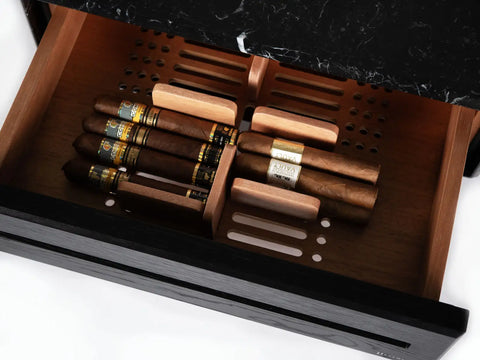
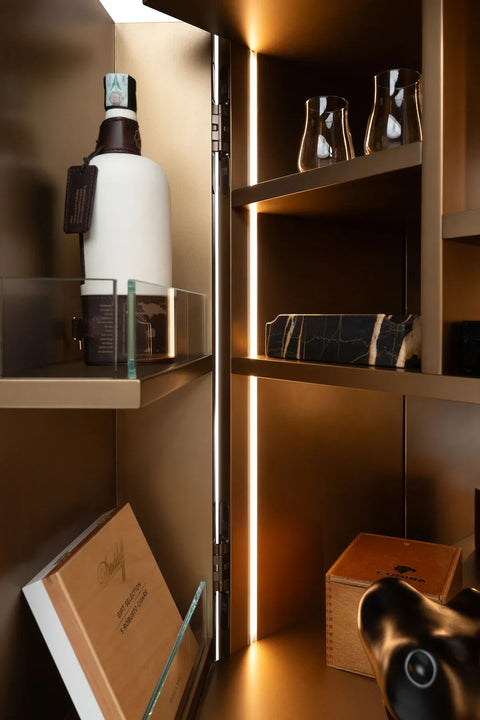
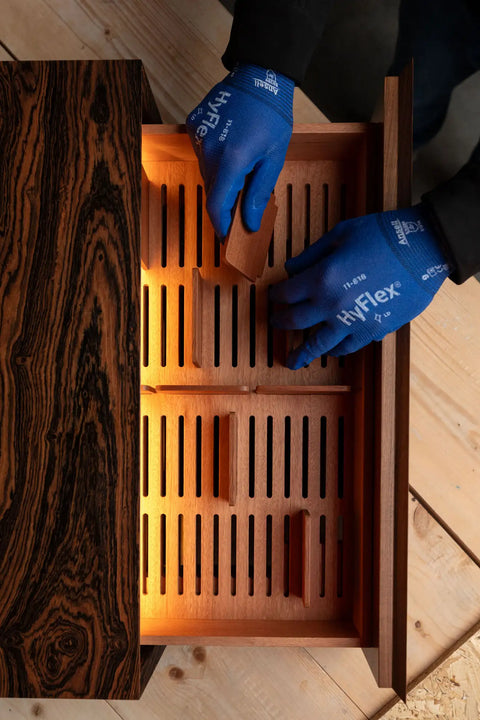
In our atelier, Nero Portoro becomes the Diamond Large humidor, our flagship. Every surface is polished entirely by hand, and every component is hand-assembled, piece by piece, in Italy. Nothing is outsourced. Inside, a stable okoumé interior and a Boveda-driven dynamic humidity system keep the climate perfectly steady, with integrated LED lighting that lifts the gold in the stone each time it opens. It is a working humidor and a sculptural object at once. See how it sits within the wider luxury humidor collection.
How Nero Portoro compares to our other stones
If Nero Portoro is drama, Nero Marquina is graphic clarity: a deep black crossed by bright white veins. Both are black marbles, but the character is different, one warm and golden, the other cool and stark. For a fuller view of the materials we work with, from stone to rare wood, see our guide to exotic woods and rare marbles, and if you are weighing stone against timber, read marble versus wood humidors.
Caring for Nero Portoro
Marble is easier to live with than most people expect. Wipe the surface with a soft, barely damp cloth, and dry it. Avoid acidic or limescale products, which etch polished stone permanently, and keep the piece out of direct sun and away from heat sources. Treated simply, Nero Portoro keeps its depth and its shine for a lifetime.
Frequently asked questions
What is Nero Portoro marble?
It is a rare black marble veined with gold and white, quarried at a single limited site near Portovenere in Italy and prized since Roman times.
Why is Nero Portoro so expensive?
The quarry is small so supply is limited, and the stone fractures along its veins, which makes it difficult to cut and polish and gives a low yield from each block. Much of the work is done by hand.
Is every Nero Portoro piece unique?
Yes. No two blocks share the same veining, so every finished piece has a pattern that will never be repeated.
How do I care for a Nero Portoro humidor?
Wipe with a soft, barely damp cloth, avoid acidic or abrasive products, and keep it out of direct sun. That is all it needs.
Which Litolite humidor is made from Nero Portoro?
The Diamond Large humidor is carved from Nero Portoro, hand-polished and handmade in Italy, with a Boveda-driven humidity system and LED lighting.