A cigar can survive a mediocre cutter. It rarely survives a bad light. The flame is the last thing that touches the tobacco before you taste it, which is why serious smokers care as much about what lights the cigar as what fills the humidor. Today that almost always means a torch flame, and increasingly, a triple-jet one.

A short history of lighting a cigar
Long before butane, the accepted way to light a cigar was with a wooden spill or a cedar match, a thin strip of wood lit from a candle or a fire and touched to the foot. The point was never tradition for its own sake: an open wood flame burns clean, with none of the sulphur taste of a struck match head or, later, the faint fuel note a careless butane flame can leave behind. As lighters modernised through the twentieth century, the classic soft, yellow butane flame became the default, simple and cheap, but soft flames struggle in wind and can singe a wrapper before the foot itself has caught. The torch, or jet, flame solved both problems: a narrow, high-pressure stream of butane burning almost completely, so it runs hotter, holds steady outdoors and leaves no fuel taste on the tobacco. It has been the standard for serious cigar smokers for decades now.
Why a triple jet beats a single flame
A single torch flame lights a small ring gauge well enough, but toast a 60-plus ring gauge cigar with one narrow jet and you end up rotating the cigar slowly, again and again, to bring the whole foot up to an even glow before you draw. A triple-jet lighter arranges three flames around the foot, so the full circumference toasts at once. The advantages are practical rather than decorative:
- Even toasting on large ring gauges, with no cold spot that leads to an uneven burn later in the smoke.
- Faster lighting, useful the moment a table of guests all reach for a cigar at once.
- Wind resistance, so a terrace or a covered patio is no obstacle.
- No direct contact needed between the flame and the wrapper leaf itself, which single soft flames make harder to avoid.
Table lighter or pocket torch?
A pocket torch is built to travel: light, compact, refilled on the go. A table lighter is built for the opposite reason. Left permanently on a desk, a bar cart or beside the humidor, it never needs to be found, and its weight and material become part of the room rather than something tucked away in a pocket. That extra scale and permanence is also what lets a table lighter become an object in its own right rather than a purely functional tool, which is exactly the idea behind La Casona.
La Casona: when a lighter becomes an object
La Casona is carved from a solid block of white Carrara marble and finished with a hand-painted micro-relief depicting Cuban scenery, a collaboration with La Casona Cubana, so no two pieces are ever quite identical. Inside that 2.5 kg block of stone sits a refillable triple-jet torch mechanism, windproof and precise, exactly the flame described above. It is a genuine limited edition: part functional lighter, part small sculpture, meant to sit on a desk or a cigar lounge table and be noticed as much as used.
Caring for a torch lighter
A torch mechanism is simple to live with. Refill with quality butane gas rather than a cheap unfiltered can, which is the single biggest cause of a clogged or sputtering flame, and give it an occasional purge if the flame becomes uneven. On a marble piece like La Casona, clean the stone with a soft, barely damp cloth only, since acidic or abrasive products can etch polished marble and dull the hand-painted surface permanently.
Explore more
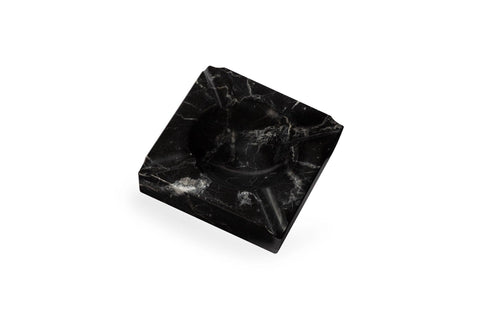
See the full table lighter collection, pair La Casona with its matching humidor and ashtray set, or browse our luxury humidors and marble ashtrays to complete the setting.
Frequently asked questions
What is a triple-flame torch lighter?
A lighter that uses three narrow, high-pressure jet flames instead of one soft flame, so the full foot of a cigar toasts evenly and quickly, even outdoors.
Why do cigar smokers prefer torch lighters over soft-flame lighters?
A torch flame burns hotter and more completely, holds steady in wind, and leaves no fuel taste on the tobacco, unlike a soft butane flame that can singe the wrapper or taint the taste.
What is the difference between a table lighter and a pocket lighter?
A pocket lighter is built to be portable and compact. A table lighter is heavier and stays in one place, on a desk or lounge table, which is also what allows it to be a decorative object rather than a purely functional tool.
Is butane lighter fluid safe for cigars?
Yes, when it is a quality, well-filtered butane. Cheap, unfiltered gas is the main cause of a sputtering or uneven flame and can leave a faint odour on the tobacco.
What makes La Casona different from a standard torch lighter?
It is carved from solid white Carrara marble and finished with a hand-painted micro-relief from a collaboration with La Casona Cubana, so each piece is one of a kind, built around the same reliable triple-jet mechanism.