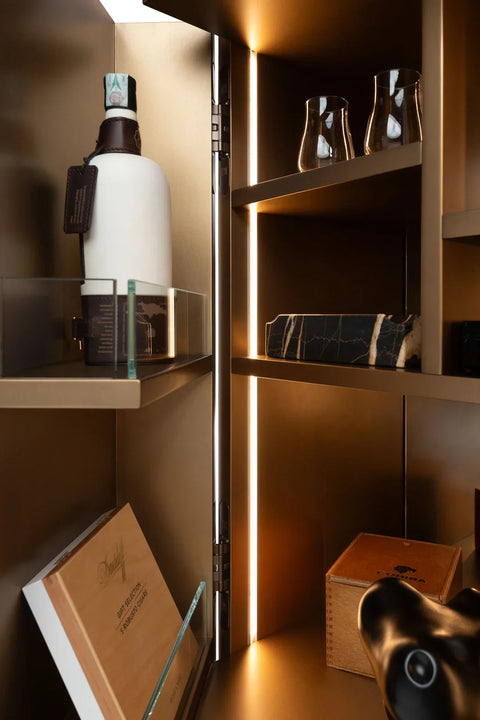
A walk-in humidor room looks like a luxury, but it is really a small building project. It has walls, a door, a climate system and a floor plan, and the mistakes that ruin cigars in a room, such as damp corners, temperature swings or a humidifier that is too small, are all decided before the first shelf is built. This guide explains what to plan first, so the room protects a collection for years instead of fighting itself.

Start with the numbers
Cigars are happiest in a narrow band of climate, and what matters most is that it stays steady. These are the targets most collectors and professionals work to:
| Parameter | Target | Why it matters |
|---|---|---|
| Relative humidity | 65 to 74% | Too dry and wrappers crack, too damp and cigars burn badly and invite mould |
| Temperature | About 18 to 21 °C (65 to 70 °F) | Humidity follows temperature, so a stable temperature keeps humidity stable |
| Ceiling | Stay below about 24 °C (75 °F) | Above it, tobacco beetle eggs can hatch inside a cigar |
A room that holds a steady humidity and temperature with small, slow changes is better than one that chases perfect numbers and swings between them. Stability is the real specification.
Choose the location and design the whole room
Place the room away from outside walls, windows, kitchens, radiators and anything that produces heat or moisture. The entire room is then designed to hold temperature and humidity, insulation included, rather than relying on equipment to compensate for a leaky space. The door should be solid or sealed glass with proper gaskets, because a door that leaks is the most common reason a room cannot hold its climate. Keep direct sunlight out entirely.
Electronic humidification and temperature control
In a room, humidity and temperature are managed by electronic systems that control both to a target, not by passive solutions, which make no sense at this volume. The system has to be sized for the real volume of air, and underestimating this is where most rooms go wrong. Large motors, which are also fitted with fans, circulate the humidity through the whole space so that no area is left dry or damp. It is the same principle we explain in dynamic humidity control, scaled up for larger volumes.
Plan the airflow and the layout
Air has to circulate, so avoid packing shelves wall to wall to the ceiling. Leave gaps between shelves and the walls, and keep the humidity source away from the cigars themselves. If air does not move, you get dry spots that a single hygrometer will never reveal. Plan capacity in cigars, not boxes, and remember that capacity depends on the size of the cigar, as explained in how many cigars a humidor holds.
Lining, glass and lighting
- Lining: use a stable, odour-neutral wood such as Spanish cedar or okoumé, and avoid anything varnished or scented inside the room.
- Glass: a glass door or partition lets guests see the cigars without opening the room, but it must be laminated or double glazed and sealed.
- Lighting: use LED, which gives little heat, and keep direct light off the cigars.
Wine and cigars under one roof
Many clients want both in the same room, and it works. Wine and cigars need different climates, so the room is designed around the cigars, while the wine is kept in dedicated built-in wine refrigerators from leading makers of built-in appliances, such as Miele or Gaggenau, selected together with the client. Built into the joinery, they keep the wine at its own temperature while the room keeps a modern, seamless design.
Monitor it, then maintain it
Use calibrated hygrometers at different heights, because humidity differs between floor and ceiling. For a hotel or a club, a data logger with alerts is worth having, so a failure is noticed in minutes rather than weeks. Keep the door closed as much as possible, and see our guide to how to season a humidor for how to bring any new wood up to humidity before the cigars go in.
Common mistakes to avoid
- An undersized humidification system for the volume of the room.
- Treating insulation as an afterthought.
- A door that does not seal.
- Placing the room against a warm or outside wall.
- Keeping wine at the cigar temperature instead of in dedicated wine refrigerators.
- Trusting one hygrometer in one corner.
Planning a room or a large cabinet
Our atelier designs and builds large cabinets and walk-in humidor rooms. For a room, the whole space is designed to hold temperature and humidity, insulation included, with electronic humidification, temperature control and motors that circulate the air. If you are planning one, you can read who we work with in our guide to custom cigar cabinets for hotels, restaurants and design projects, or tell us about your space on our bespoke cabinets page.
Frequently asked questions
What temperature and humidity should a walk-in humidor room hold?
About 65 to 74% relative humidity and 18 to 21 °C, kept as steady as possible. Avoid going above roughly 24 °C, where tobacco beetle eggs can hatch.
Can a walk-in humidor and wine share the same room?
Yes. The room is designed around the cigars, and the wine is kept in built-in wine refrigerators from leading makers of built-in appliances, such as Miele or Gaggenau, integrated into the design.
How do you humidify a large humidor room?
With an electronic humidification system that controls humidity to a target, together with temperature control, and with motors fitted with fans that circulate the air through the whole space.
Does a humidor room need to be insulated?
Yes. The whole room is designed to hold temperature and humidity, insulation included, with a sealed door, so the equipment does not have to fight a leaky space.
What is the best wood for lining a humidor room?
A stable, odour-neutral wood such as Spanish cedar or okoumé. Avoid varnishes and scented finishes inside the room.
How do I monitor the climate in the room?
Use several calibrated hygrometers at different heights. For hotels and clubs, a data logger with alerts is worth adding, so any drift is caught early.