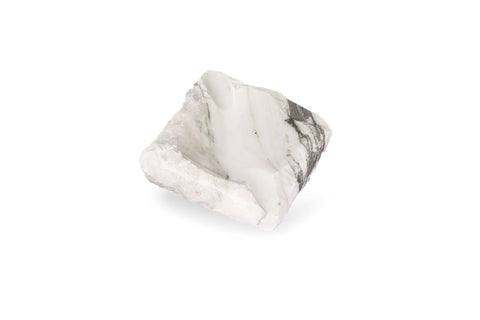
Some stones are chosen for their colour. Calacatta Oro is chosen for its drama: a bright white body crossed by bold veins of warm gold and grey, no two slabs alike. It is one of the most admired marbles in Italian design, and it makes a cigar ashtray that looks like a sculpture even when it is simply sitting on a table. This guide explains where Calacatta Oro comes from, how it differs from Carrara, and how we turn it into an ashtray.

Where Calacatta Oro comes from
Calacatta is quarried in the Apuan Alps, in the Carrara district of Tuscany, the same mountains that have supplied Italy's finest white marble for centuries. Calacatta Oro is the variety known for its warm golden veining. The Apuan Alps are also where the marble of Michelangelo's David came from. David is carved from white Carrara marble, and a scientific study in 2005 traced the block to the Fantiscritti quarries at Carrara. David is not made of Calacatta, which is a different variety, but the two share a mountain range and a tradition of stone cutting that goes back to Roman times.
Carrara, statuario and Calacatta: how to tell them apart
| Marble | Look | Character |
|---|---|---|
| Carrara | Soft, even grey-white with fine grey veining | Calm and classic |
| Statuario | Pure white to ivory, with little veining | The grade most prized for sculpture |
| Calacatta Oro | Ivory-white ground crossed by bold, warm golden veins | Dramatic, and rarer than Carrara |
The point to remember is simple: Carrara is calm, Calacatta Oro is bold.
Why the veining matters in an ashtray
In a large surface such as a floor or a countertop, the veining is a pattern. In a small object such as an ashtray, it is the whole picture, so the way it falls across the piece decides how it looks. Each slab is distinct, and the cut is chosen so the veining crosses the ashtray rather than running off one edge. That is also why no two Calacatta Oro ashtrays are ever identical, and why a photo can only show the idea, not the exact piece you will receive.
How we make a Calacatta Oro ashtray
The Calacatta Oro ashtray starts as a solid block of stone. The bowl is cut on a CNC machine, and then the outer edge is split by hand, the same way the old stonemasons worked, so the raw quarry-cut face stays exposed beside the polished hollow. Every finishing pass after the cut is done by hand, and the base carries an eco-leather backing with the Litolite logo, which is easy to clean and protects the table.

It comes in two sizes. The standard ashtray measures 16 by 16 cm and weighs 2.5 kg, with broad rests that hold a cigar securely. The large Calacatta ashtray measures 20 by 20 cm and weighs 5 kg, deep enough for the long ash of a Churchill, with rests cut wide enough for a 54 ring gauge. The weight is deliberate: a heavy stone does not shift when you put a cigar down. For the thinking behind the design, read what makes a real cigar ashtray.
Caring for a pale marble
Marble is easier to live with than most people expect, but a pale stone shows every mark. Wipe the surface with a soft, barely damp cloth and dry it. Avoid acidic or limescale products, which etch polished stone permanently, and tip out the ash after use rather than leaving it overnight. Solid marble tolerates the heat of resting ash, so simply avoid placing an open flame directly on the stone.
Building the setting around it
A Calacatta Oro ashtray works best with pieces that share its calm palette. Pair it with the Calacatta Bianco table lighter, or with the wider range of marble table lighters, and keep the cigars in a luxury humidor. If you are choosing the pieces one by one, our guide to cigar accessories explains what a collector actually needs. To compare it with the other stones in the range, see our marble ashtrays, and for the wider story of the materials we work with, read a guide to exotic woods and rare marbles. It also makes a considered gift: see luxury cigar gifts.
Frequently asked questions
Is Calacatta the marble of Michelangelo's David?
No. David is carved from white Carrara marble, and a 2005 study traced the block to the Fantiscritti quarries at Carrara. Calacatta is a different variety, but it comes from the same Apuan Alps.
What is Calacatta Oro?
Calacatta Oro is Calacatta marble with warm golden veining on a bright ivory-white ground. It is the variety we use for our Calacatta ashtray.
What is the difference between Calacatta Oro and Carrara?
Carrara is a soft, even grey-white with fine grey veining. Calacatta Oro has a brighter ground crossed by bold golden veins, and it is rarer.
Is a marble ashtray safe with hot cigar ash?
Yes. Solid marble tolerates the heat of resting ash. Simply avoid placing an open flame directly on the stone.
Will my ashtray look exactly like the photos?
No. Each piece is cut from natural marble, so veining and tone vary and no two are ever alike.
How do I clean a Calacatta Oro ashtray?
Wipe it with a soft, barely damp cloth and dry it. Avoid acidic, limescale or abrasive products, which etch polished marble permanently.