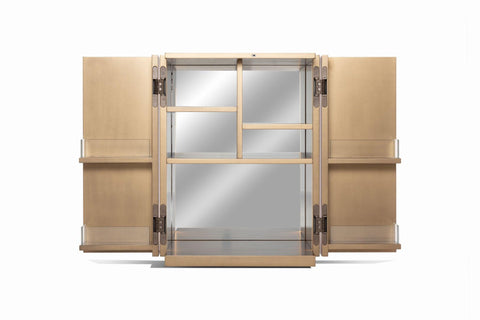
Your hygrometer reads a perfect 69%, yet one cigar draws beautifully while another feels dry at the foot or spongy near the cap. The number is right, so what is wrong? The answer is almost always the same: dry spots. Humidity inside a sealed box is rarely as even as a single reading suggests, and those hidden pockets are one of the most common reasons good cigars underperform.

What is a dry spot?
A dry spot is simply an area inside the humidor where the relative humidity sits lower than where your humidity pack and hygrometer are. Tobacco is constantly exchanging moisture with the air around it, so a cigar resting in a drier corner slowly gives up moisture, while one sitting next to the source stays plump. Over weeks, two identical cigars in the same box can end up at two different moisture levels, and you only discover it when one burns hot and cracks while the other draws tight.
Why humidity is never naturally even
A humidor is a small sealed climate, and like any climate it is not uniform on its own. Moisture is released from one place, usually where the packs sit, and it has to travel to reach the rest of the box. Several things work against an even spread:
- Distance from the source: the far end of the box is the last place moisture reaches, so it trends dry.
- Opening the lid: every time you open a humidor, conditioned air escapes and dry room air rushes in, and it settles unevenly.
- Temperature differences: a side near a window or a warm wall behaves differently from the shaded side.
- Overpacking: cigars crammed tight block air from moving, so moisture never reaches the middle of the bundle.
In a compact desk humidor the distances are short and the air settles quickly, so the problem is small. In a larger box or a cabinet, the gradient has room to grow.
The signs your humidor has dry spots
- Cigars from the same box burn or draw differently.
- Wrappers feel crisp at the back of the box but supple near the packs.
- An uneven or fast, hot burn on a cigar that should be smooth.
- The hygrometer reads correctly, yet the cigars tell a different story.
That last point is the trap: a single hygrometer only measures its own corner. A reading of 69% tells you nothing about the far end of a large humidor.
Why larger humidors suffer most
The bigger the interior, the further moisture has to travel and the longer a gradient can persist. A desk humidor of forty centimetres settles on its own; a cabinet approaching seventy centimetres or more will hold a dry end and a damp end at the same time unless something moves the air. This is exactly the point where passive humidity control, however good the packs, stops being enough on its own.
The fix: gentle air circulation
The reliable way to erase dry spots is to keep the internal air gently moving so moisture is shared evenly across every shelf. The key word is gentle: the goal is to even out the climate, never to blow air across the cigars, which would dry the wrappers. Done correctly, circulation removes the gradient before it can form and leaves one single, stable microclimate.
This is how Litolite solves it in our larger humidors. A dynamic humidity control system uses silent, low-RPM fans that activate briefly once a day to circulate the moisture produced by the Boveda packs through the whole chamber. It is slow and near-silent by design, enough to keep the interior uniform without ever drying the tobacco. The result is that the cigar at the back ages exactly like the one at the front.
What you can do about dry spots
Whether or not your humidor has a circulation system, a few habits keep humidity even:
- Rotate your cigars every few weeks so none sits permanently in the driest corner.
- Do not overpack. Leave a little room for air to move between bundles.
- Distribute your packs. Place humidity packs in more than one spot rather than all together, and start with a Boveda starter kit sized to your capacity.
- Check the seal. A humidor that leaks air will always fight an uneven climate; a proper seasoned, airtight box holds moisture far better.
- For a larger collection, choose active circulation. Once you pass desk scale, a humidor with built-in dynamic airflow removes the problem for you.
Frequently asked questions
What causes dry spots in a humidor?
Uneven humidity: moisture is released from one area and struggles to reach the rest of the box, so corners far from the packs trend dry. Opening the lid, temperature differences and overpacking all make it worse.
My hygrometer reads 69%, so why are my cigars dry?
A single hygrometer only measures its own spot. In a larger humidor the far end can sit several points lower while the reading near the packs looks perfect. The fix is even air distribution, not a higher number.
Will a fan dry out my cigars?
Not if it is done correctly. A proper system moves air slowly and briefly to even out humidity, never blowing across the cigars. Litolite fans run at low RPM once a day and are near-silent.
Do small humidors need air circulation?
Usually no. At desk scale the distances are short and a static two-way pack system keeps things even. Circulation earns its place once you move to a large box or cabinet.
How do I fix dry spots in a humidor I already own?
Rotate the cigars regularly, avoid overpacking, spread your humidity packs across the box, and make sure the seal is good and the humidor was seasoned before first use.